
Results at a glance
🕒 Hours saved weekly: ~2–3 hours/week (through automation and fewer follow-ups)
👥 Team using Koalendar: Self-employed consultant running presentations + trainee workshops
📅 Years using Koalendar: 2,5 year
⭐ Top benefit: Fewer back-and-forth messages, and a much more reliable show-up rate: “If 20 people tell they come… around 19 will actually come.”
Overview
We spoke with Raphael Krug, a self-employed financial planner working within Germany’s biggest free financial consulting company (Deutsche Vermögensberatung AG) focused on credits, insurance, and investments. The organization he works for operates as a large network of self-employed consultants across Germany, Switzerland, and Austria, with around 8 million customers in Germany alone and Raphael’s agency has over 2,000 clients.
Alongside client work, Raphael also hires and trains new people, which means running recurring presentations, onboarding steps, and workshops week after week.
The challenge: Microsoft restrictions turned scheduling into a weekly headache
The goal was simple: Create a reliable onboarding “process chain” where interested candidates and trainees couldbook their own training sessions without constant coordination.
But the team’s Microsoft environment made that surprisingly hard.
Because they use a special Microsoft license tied to German servers for client data, it limited what he could do inside the Microsoft ecosystem. In practice, that meant:
- He couldn’t create the kind of parallel “rooms” / calendars he needed (e.g., multiple bookable schedules).
- He was restricted to one email URL / one calendar, which blocked the setup he wanted.
- Booking was also limited because people could only book if their email was registered in advance, forcing manual work just to let someone schedule.
- Attempts to create a separate Microsoft account + license turned into hours of dead ends (“around six or eight hours”) and support wasn’t helpful.
Additionally, before Koalendar, even after invitations went out, Raphael still had to chase confirmations and manage last-minute uncertainty:
- “Sometimes 20 [people came], sometimes 8.”
- Lots of follow-ups, costly in time, especially because everyone is busy and self-employed.
The result: Too much admin, too many follow-ups, and a process that didn’t scale with weekly onboarding.
Solution: One link, simple booking, and a system that just works
After hitting a wall with Microsoft, Raphael started Googling alternatives. Koalendar stood out as an easy option for his use case, especially because it worked smoothly with Google Calendar and didn’t require complex “room” email setups.
What mattered most was straightforward, reliable scheduling. As Raphael puts it:
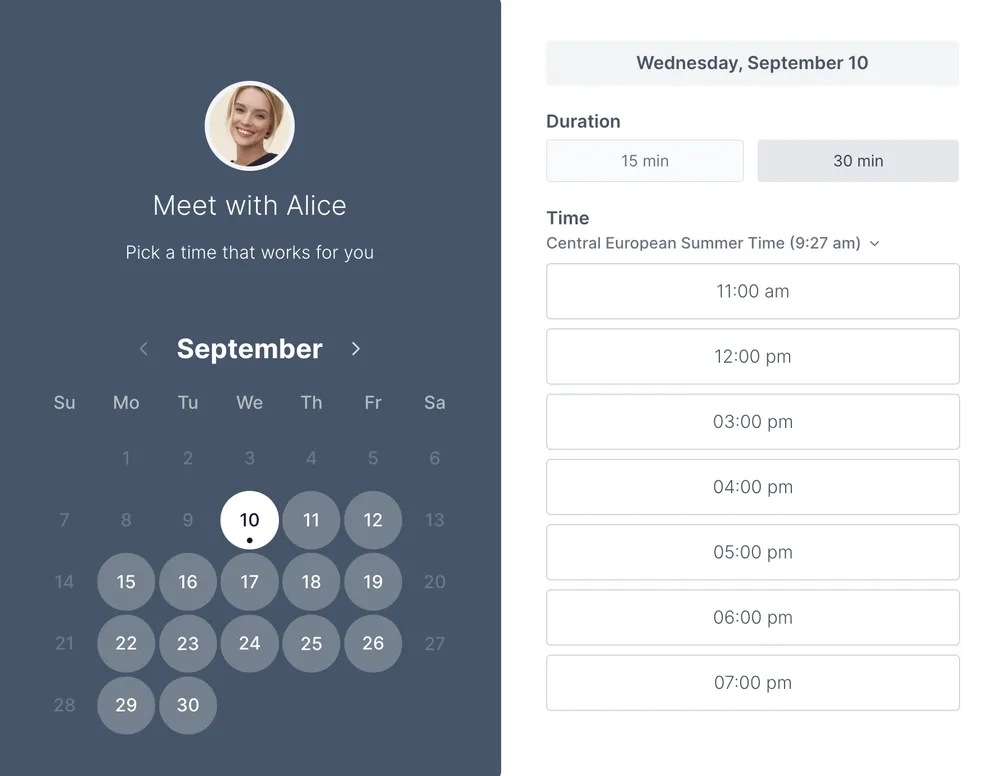
“I wanted to have just one link, click, do the sign in. That’s it.”
He tested Koalendar and quickly saw it fit his workflow, then upgraded to Pro the same day. Pricing flexibility helped, too, because he needed extra rooms sometimes, but not always, and Koalendar’s model felt scalable.
How he set it up
To keep everything organized, he built a Microsoft Sway page that acts like a simple directory of links:
- Links for client presentations
- Links for job-interest presentations
- Links for multi-step onboarding sessions
- Some links route to other consultants’ booking pages, while others route to the shared Koalendar scheduling flow
So instead of explaining availability every week, they just share one page, and people choose the right booking path.
The outcome: Fewer no-shows, less hassle, and clear weekly visibility
Once Koalendar was in place, the biggest day-to-day win was cutting down the “Are you coming?” communication spiral.
“With Koalendar booking has become more binding, because people enter their details and actively commit. They also receive reminders. Now, if 20 people say they are coming, around 19 will actually come.”

Raphael Krug
Financial Expert
That reliability changes planning. He can now open Koalendar on his phone and instantly see:
- How many people are booked for next week’s presentations
- Which workshops are already full
- Whether they have enough colleagues assigned to run sessions
For Raphael, Koalendar became the easiest way to run a reliable weekly onboarding and presentation flow:
✅ One simple booking link (via his Sway page) for candidates, trainees, and client presentations
✅ Far fewer follow-up messages to confirm attendance
✅ Clear weekly visibility into what’s booked (workshops, presentations, and capacity) right from his phone
✅ 2–3 hours saved per week through automated scheduling and less manual coordination
✅ Better tracking of workshop history and key KPIs (attendance, invites, and consultant performance)
Conclusion: One link that keeps onboarding moving
For Raphael, Koalendar turned a messy, manual scheduling routine into a repeatable system that runs week after week, without the Microsoft limitations, email chasing, or uncertainty around attendance.
With a simple set of booking links and clear visibility into what’s coming up, he and his colleagues can spend less time coordinating logistics and more time running strong presentations, workshops, and training sessions.
Want to simplify scheduling the same way? Create your booking link with Koalendar and let the process run itself.